-
Flight Info
-
Transportation
-
Service Facilities
-
Shopping&Dining


Civil Aviation Administration of China: Power banks without 3C certification or recalled models banned on domestic flights
To ensure the safety of aviation operations, the Civil Aviation Administration of China has issued an urgent notice. Starting June 28, passengers are prohibited from carrying power banks that lack a 3C certification label, have unclear 3C labeling, or belong to recalled models or batches on domestic flights. (For details, please visit the official website of the State Administration for Market Regulation's Defective Product Recall Technical Center at www.samrdprc.org.cn/xfpzh/xfpgnzh)
Pudong Airport and Hongqiao Airport will enforce the requirements of this notice to ensure passenger safety. We kindly ask all passengers to comply with this notice by carefully checking the certification label, brand, and model of your power banks before traveling. Please do not bring non-compliant power banks on board. Remove your power bank before security checks to prevent travel delays.
Thank you for your understanding and cooperation.
Hoisting of the steel roof structure for the international building at Pudong airport's Terminal 3 began on Oct 13, marking a major milestone in the airport's Phase IV expansion. The structure is now nearing topping out.
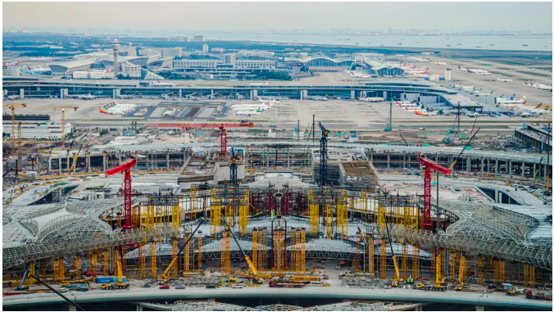
An aerial view of Terminal 3 at Pudong airport. [Photo/AVINEX]
The roof is the centerpiece of T3's bird-in-flight design and is intended to become the terminal's most recognizable landmark. The entire steel structure weighs 202,000 metric tons, about five times the amount of steel used in the Burj Khalifa, the world's tallest building, according to the project team.
The roof section being lifted covers 25,000 square meters and weighs about 6,000 tons. It will be raised 16 meters — roughly the height of a five-story building — using 39 lifting points and 41 intelligent hydraulic jacks, all controlled by a cluster-synchronized system that delivers millimeter-level precision.
According to the builders, the project marks a first in China’s civil aviation sector by abandoning the conventional high-altitude assembly method. Instead, five systems — the steel skeleton, metal roof, skylights, maintenance walkways, and mechanical and electrical systems — were fully assembled on the ground and then lifted as a single finished unit.
After the lifting, work will shift to the metal roofing, curtain walls, and interior decoration.