-
Flight Info
-
Transportation
-
Service Facilities
-
Shopping&Dining


Civil Aviation Administration of China: Power banks without 3C certification or recalled models banned on domestic flights
To ensure the safety of aviation operations, the Civil Aviation Administration of China has issued an urgent notice. Starting June 28, passengers are prohibited from carrying power banks that lack a 3C certification label, have unclear 3C labeling, or belong to recalled models or batches on domestic flights. (For details, please visit the official website of the State Administration for Market Regulation's Defective Product Recall Technical Center at www.samrdprc.org.cn/xfpzh/xfpgnzh)
Pudong Airport and Hongqiao Airport will enforce the requirements of this notice to ensure passenger safety. We kindly ask all passengers to comply with this notice by carefully checking the certification label, brand, and model of your power banks before traveling. Please do not bring non-compliant power banks on board. Remove your power bank before security checks to prevent travel delays.
Thank you for your understanding and cooperation.
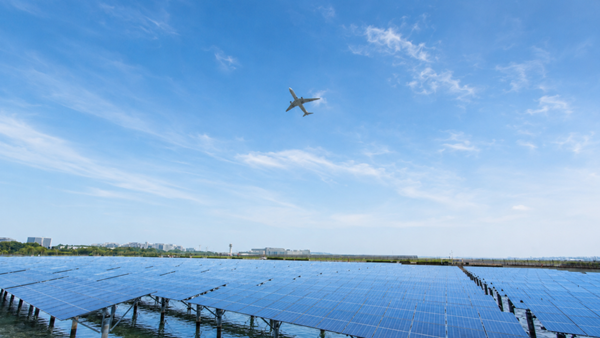
A photovoltaic project at Hongqiao Airport. [Photo/WeChat account of AVINEX]
Photovoltaic projects at Hongqiao Airport and Pudong Airport have recently been completed and put into operation.
The projects integrate photovoltaic generation with airport-specific safety and operational requirements, offering a replicable model for airports to make use of idle space while developing clean energy.
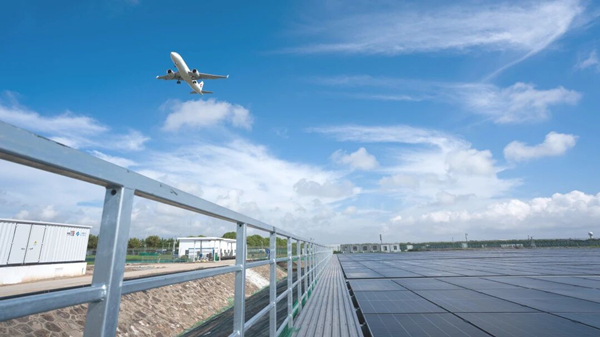
A photovoltaic project at Pudong Airport. [Photo/WeChat account of AVINEX]
The two projects can generate about 14 million kilowatt hours of electricity annually and reduce carbon emissions by approximately 7,400 metric tons. The power output is sufficient for self-consumption, with any surplus fed into the grid.
The solar panel installations also help reduce water-surface glare and discourage bird activity, providing additional safeguards against bird strikes.
Given their proximity to runways, the projects faced stringent airspace and construction safety requirements. Specialized equipment and a full-process foreign object debris management system were adopted to minimize any impact on flight operations.
The projects also feature customized solutions to address three key challenges: bird strike prevention, glare control and wind resistance. High-density protective mesh was integrated with the photovoltaic system to deter birds, while low-reflection modules and optimized installation angles minimize glare. The support structures were designed to withstand winds equivalent to Category 13 typhoons.
Shanghai Airport has been steadily expanding distributed photovoltaic applications across water surfaces, rooftops and other airport facilities, with further expansions planned alongside the phase-IV expansion of Pudong Airport.