-
Flight Info
-
Transportation
-
Service Facilities
-
Shopping&Dining


Civil Aviation Administration of China: Power banks without 3C certification or recalled models banned on domestic flights
To ensure the safety of aviation operations, the Civil Aviation Administration of China has issued an urgent notice. Starting June 28, passengers are prohibited from carrying power banks that lack a 3C certification label, have unclear 3C labeling, or belong to recalled models or batches on domestic flights. (For details, please visit the official website of the State Administration for Market Regulation's Defective Product Recall Technical Center at www.samrdprc.org.cn/xfpzh/xfpgnzh)
Pudong Airport and Hongqiao Airport will enforce the requirements of this notice to ensure passenger safety. We kindly ask all passengers to comply with this notice by carefully checking the certification label, brand, and model of your power banks before traveling. Please do not bring non-compliant power banks on board. Remove your power bank before security checks to prevent travel delays.
Thank you for your understanding and cooperation.
A major construction milestone for Terminal 3 of Shanghai Pudong International Airport's Phase IV expansion was reached on July 23, when the final cast-steel branching section of the terminal's signature "bird in flight" column was successfully installed.
With all 17 such columns now in place, the core structural support system for the terminal's iconic roof is complete, paving the way for the next stage of steel roof assembly.
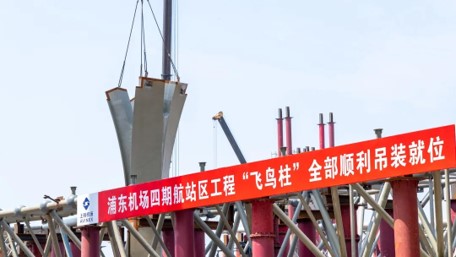
The last "bird in flight" column being installed. [Photo/WeChat account of AVINEX]
The installation marks several engineering breakthroughs. Each column features a unique, four-branched, spatially twisted geometry, and the project pioneers the large-scale use of ultra-high-strength cast steel components in a major domestic structure. Advanced technologies, including parametric modeling, 3D simulation, BIM, and digital precision monitoring, enabled millimeter-level installation accuracy throughout the project.
The final column installed was the tallest and heaviest among the 17 columns, weighing more than 80 metric tons. As one of the most technically demanding lifts in the project, its successful installation signified the completion of the terminal's key structural system and showcased the project's advanced engineering and digital construction skills.