-
Flight Info
-
Transportation
-
Service Facilities
-
Shopping&Dining


Civil Aviation Administration of China: Power banks without 3C certification or recalled models banned on domestic flights
To ensure the safety of aviation operations, the Civil Aviation Administration of China has issued an urgent notice. Starting June 28, passengers are prohibited from carrying power banks that lack a 3C certification label, have unclear 3C labeling, or belong to recalled models or batches on domestic flights. (For details, please visit the official website of the State Administration for Market Regulation's Defective Product Recall Technical Center at www.samrdprc.org.cn/xfpzh/xfpgnzh)
Pudong Airport and Hongqiao Airport will enforce the requirements of this notice to ensure passenger safety. We kindly ask all passengers to comply with this notice by carefully checking the certification label, brand, and model of your power banks before traveling. Please do not bring non-compliant power banks on board. Remove your power bank before security checks to prevent travel delays.
Thank you for your understanding and cooperation.
Shanghai Pudong International Airport has reduced the average aircraft pushback waiting time by about 2 minutes after introducing an intelligent flight sequencing system in 2024, improving ground coordination efficiency and enabling smoother runway and taxiway operations across the busy hub.
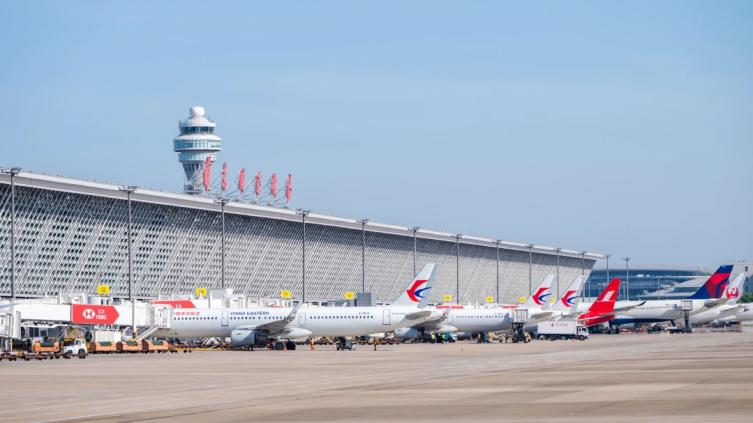
Planes parked at Pudong Airport. [Photo/WeChat account of AVINEX]
The system shifts ground control from experience-based judgment to predictive, data-driven management by integrating airport collaborative decision-making (A-CDM) systems with tower electronic flight progress strips, enabling real-time information sharing among air traffic control, airport operators and airlines.
Based on key operational parameters including departure flow intervals, allocated time slots, aircraft types and parking stands, an algorithm automatically generates optimized pushback sequences and targets start-up approval times (TSAT), which are displayed through gate guidance systems for unified execution across all ground teams.
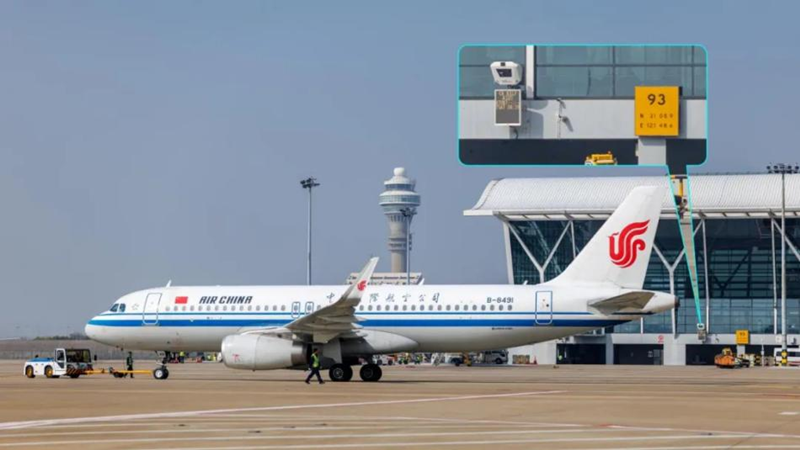
Air China. [Photo/WeChat account of AVINEX]

TSAT is displayed via the gate guidance system, allowing all ground staff to work toward the same precise pushback time. [Photo/WeChat account of AVINEX]
Since the system was launched, average aircraft taxi-out time has been reduced by around 1.7 percent. With 278,500 outbound flights handled in 2025, the airport has saved more than 9,200 hours of pushback waiting time annually across operations.
These efficiency gains have also led to fuel savings exceeding 9,000 metric tons for airlines, equivalent to about 55 million yuan ($8.11 million). At the same time, overall flight punctuality at Pudong Airport increased by 2.14 percent during peak travel periods such as the Spring Festival and summer peak seasons.
The core technology behind the system, "multi-runway multi-terminal airport TSAT optimization technology and application," won third prize in the Civil Aviation Science and Technology Award issued by the China Air Transport Association, highlighting its role in advancing intelligent civil aviation operations in China.
The system also helps mitigate congestion during peak seasons by replacing manual coordination with algorithm-driven scheduling, allowing ground service teams to align operations more precisely and reduce variability in aircraft pushback timing across terminals.